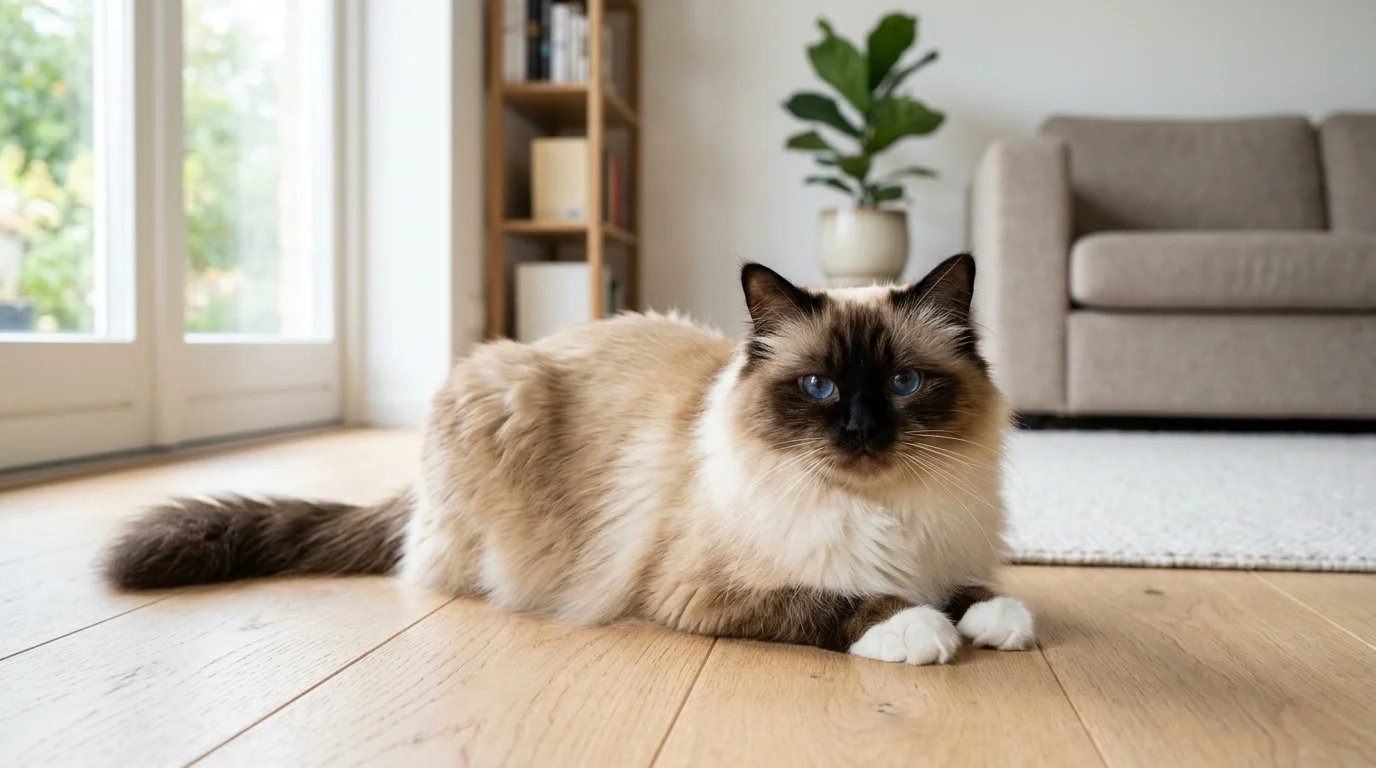

Birman
gentle, affectionate, quiet, docile
Quick Facts
- Lifespan
- 12-16 years
- Weight
- 3.6-6.8 kg
- Origin
- France/Myanmar
- Coat
- Medium
Overview
The Birman, also known as the Sacred Cat of Burma, is a strikingly beautiful breed distinguished by its silky semi-long coat, deep blue eyes, and characteristic white gloves on all four paws. Gentle, affectionate, and quietly devoted, the Birman is considered one of the most companionable breeds in the cat world.
Weighing between 3.6 and 6.8 kg and living 12 to 16 years, Birmans are medium-to-large cats with a calm, adaptable nature that suits families, seniors, and multi-pet households alike. They are recognized by CFA, TICA, FIFe, and GCCF.
History & Origins
The Birman's origins are wrapped in legend. One story tells of sacred cats kept in Burmese temples that were believed to embody the souls of deceased priests. According to the tale, a pure white cat took on the golden hue of a goddess and deep blue eyes after its owner, a high priest, died — and the white gloves on the paws where the cat touched the priest remained as a symbol of purity.
Historically, the breed was developed and standardized in France in the early 20th century, likely from crosses between longhaired cats imported from Asia and Siamese. The Birman was officially recognized in France in 1925 and reached the United States after World War II, gaining CFA recognition in 1967.
Appearance
The Birman has a broad, rounded head, full cheeks, and a distinctly Roman nose that gives the face a soft, approachable look. Their most iconic physical feature is the pure white "gloves" on all four paws — a precise marking standard that distinguishes them from other colorpoint breeds.
The coat is silky, medium-long, and comes in all traditional colorpoint patterns: seal, chocolate, blue, lilac, red, and cream. Unlike the Persian, the coat lies relatively flat and does not mat easily. The deep blue eyes are one of the breed's most captivating features and are consistent across all color varieties.
Temperament
Birmans are quintessentially gentle companions. They have a moderate activity level and enjoy interactive play without the relentless energy of more athletic breeds. Birmans tend to follow their owners around the home, checking in frequently, but they do so quietly and without demanding attention loudly.
They are highly social and typically get along well with children, other cats, and cat-friendly dogs. Their docile nature makes them easy to handle and a good match for less experienced cat owners. Birmans dislike being left alone for long periods and flourish in households where they receive consistent affection and company.
Activity & Play
Activity & Exercise
Birmans have a moderate activity level that sits comfortably between the laid-back Persian and the frenetic Abyssinian. They enjoy play but are equally happy curling up beside you on the sofa. This makes them one of the more relaxed breeds to live with, though they still need daily engagement to stay healthy.
Aim for 2 sessions of 10-15 minutes of interactive play per day. Birmans will not usually seek out vigorous activity on their own, so it is up to their owners to initiate sessions. Left to their own devices, they tend to nap rather than exercise.
Best toys and games:
- Feather wands and dangling ribbon toys (encourage gentle pouncing)
- Soft plush mice and crinkle balls for solo batting
- Puzzle feeders to add mental stimulation without demanding high physical output
- Cat trees and scratch posts (Birmans do enjoy climbing, though not at the intensity of more active breeds)
Indoor vs. outdoor tolerance: Birmans are well-suited to indoor life. They are not particularly driven to roam outdoors and their calm temperament means they settle happily in apartments and smaller homes. An indoor Birman needs a cat tree or elevated perch to satisfy any climbing instinct, and a window perch where they can watch the world goes a long way.
Because Birmans are prone to weight gain, structured daily play is genuinely important for their health, not just their happiness. A Birman that becomes sedentary and overeats can develop obesity-related conditions including joint stress and diabetes. Two or three deliberate play sessions a day, combined with portion-controlled feeding, keeps their weight in check.
Grooming
Despite its luxurious semi-long coat, the Birman is easier to groom than most longhaired breeds because its silky fur is relatively tangle-resistant and lacks a dense undercoat. Brushing two to three times per week is generally sufficient to keep the coat smooth and free of loose hair.
Pay particular attention to the areas behind the ears, under the arms, and along the hindquarters where tangles are most likely to develop. Their white paw gloves may require occasional spot-cleaning to stay pristine. Routine nail trimming and periodic ear cleaning complete a straightforward grooming schedule.
Health
Birmans are generally a healthy breed with a solid lifespan of 12 to 16 years, but they do have known predispositions to certain conditions. Chronic kidney disease can develop as the breed ages, making regular kidney function screening an important part of veterinary care for older Birmans. Feline infectious peritonitis (FIP) has been noted with slightly higher prevalence in the breed, and urate urolithiasis — the formation of urate crystals in the urinary tract — is another condition to monitor.
Breeders who prioritize health testing and transparent breeding practices help reduce the incidence of these issues. Annual veterinary check-ups with bloodwork are strongly recommended.
Nutrition
Nutrition
Birmans are obligate carnivores with a healthy appetite and a real tendency toward weight gain, so nutrition and portion control deserve careful attention throughout their life.
Protein: The foundation of a Birman's diet should be high-quality animal protein. Look for foods where chicken, turkey, salmon, or another named meat is the first ingredient. Protein supports muscle maintenance, which is important for a breed that can become sedentary.
Fat: A moderate fat content supports energy levels and coat health. The Birman's semi-long, silky coat benefits from omega-3 and omega-6 fatty acids found in fish-based foods or supplements.
Carbohydrates: Keep these minimal. Birmans are not particularly active and can gain weight easily on carbohydrate-heavy diets. Avoid foods with corn, wheat, or potato as primary ingredients.
Wet vs. dry food: Wet food is generally recommended as the primary option, particularly for indoor cats that may not drink enough water independently. Birmans are not known for drinking heavily, and good hydration helps protect kidney function over the long term. Dry food can be offered as a supplement for dental benefits, but should not be the sole food source.
Feeding schedule:
- Kittens: 3 meals per day
- Adults (1-7 years): 2 meals per day with measured portions
- Seniors (7+): 2 meals per day; consider senior-formulated food with joint support ingredients
Breed-specific considerations: Weight management is the main nutritional priority for Birmans. Obesity is a real risk with this breed due to their moderate activity level and good appetite. Weigh portions rather than estimating, and adjust as needed based on your cat's body condition. Hypertrophic cardiomyopathy (HCM) is the main known health concern in Birmans; while diet cannot prevent it, maintaining a healthy weight reduces cardiac strain.
Family Fit
Family Fit
Birmans are one of the gentlest and most adaptable cat breeds available, making them an excellent choice for a wide range of households.
Families with children: Birmans are patient, gentle, and tolerant, which makes them a strong match for families with children of all ages. They are unlikely to scratch or bite even when handled clumsily, though teaching young children to handle pets respectfully is always worthwhile. Birmans enjoy gentle interaction and will often seek out children for company.
Other cats: Birmans tend to get along well with other cats. Their calm, non-territorial nature means introductions usually go smoothly. They are social enough to benefit from feline companionship, particularly if their owners are out during the day.
Dogs: Birmans typically coexist peacefully with calm, well-mannered dogs. Their laid-back personality means they do not tend to react with panic or aggression to canine housemates, though high-energy dogs may occasionally stress them. A calm, trained dog is the ideal companion.
Elderly owners: Birmans are a genuinely good match for seniors. Their moderate activity level means they do not require constant high-energy play, they enjoy quiet companionship, and their affectionate nature provides real comfort without being demanding.
Apartment dwellers: Excellent apartment cats. Birmans do not need outdoor access, do not demand high ceilings or elaborate climbing structures (though these are appreciated), and their moderate noise level makes them considerate neighbors.
First-time cat owners: Among the best choices for first-time owners. Birmans are forgiving, gentle, and straightforward to care for. Their grooming needs are moderate despite their semi-long coat, and their temperament is predictable and warm.
Fun Facts
The Birman nearly went extinct during World War II — surviving pairs were used to rebuild the entire breed from scratch in postwar France. The breed is sometimes called the "Sacred Cat of Burma," though it was formally developed as a breed in France rather than Burma. All Birmans are born entirely white and develop their colorpoint markings and blue eyes as they mature over the first few weeks of life. Their white gloves must be symmetrical on the front paws and extend further up the back legs in a shape called "laces" to meet the CFA show standard.
FAQ
Frequently Asked Questions
How long do Birmans live?
Birmans typically live 12 to 16 years, with some individuals reaching 17 or 18 years with excellent care. The range in sources varies (9-15 years on the low end, up to 18 on the high end), so 12-16 years is a reasonable expectation for a healthy, well-cared-for Birman.
Do Birmans shed a lot?
Birmans have a medium-to-long silky coat that does shed, but somewhat less than other longhaired breeds because their coat lacks the dense undercoat that causes heavy shedding. Weekly brushing is generally enough to manage loose hair and prevent tangles. Expect some seasonal increase in shedding.
Are Birmans vocal cats?
Birmans are moderately vocal. They will communicate with a soft, pleasant voice when they want attention or food, but they are not persistently loud like Siamese cats. Most Birman owners describe their cat's voice as gentle and easy to live with.
Are Birmans good for people with allergies?
Birmans are not classified as hypoallergenic. All cats produce the Fel d 1 protein, which is the main allergen for most people. Birmans do not produce notably less of this protein than other breeds, so they are not a reliable choice for allergy sufferers.
How much does a Birman kitten cost?
Birman kittens from reputable breeders typically cost between $800 and $2,000 USD depending on location, breeder reputation, and whether the kitten is pet-quality or show-quality. Adoption through a breed-specific rescue is a more affordable alternative.
Are Birmans good with children and other pets?
Yes, Birmans are among the most child- and pet-friendly cat breeds. Their patient, gentle temperament means they tolerate handling well and adapt to busy family environments. They typically get along with other cats and calm dogs, making them a flexible choice for multi-pet households.
Gallery
Explore more Birman-style breeds
Browse related breeds or take our matching quiz to find the right fit for your home.
Stay in the loop
Get weekly breed spotlights, care guides, and new additions - straight to your inbox.